
NC State history professor Tate Paulette carefully carried his bin of mashed sourdough to the fermentation vessel. He studied the small opening at the top and started to pour.
A stream of clumpy mush, tinged dusty pink from the addition of date syrup, flowed into the hole. It was Paulette’s interpretation of bappir, an ancient and relatively uncertain ingredient that some of the world’s first brewers used to make beer in Mesopotamia.
“You’re like the world’s current expert in bappir pouring,” said Les Stewart, brewmaster at Trophy Brewing and Paulette’s ancient brewing partner. “There was a time when you might have had competition.”
It has indeed been a while — roughly 4,500 years — since Sumerians widely consumed the ancient brew they were making. But this fall, Paulette and Stewart teamed up to bring it back to life.
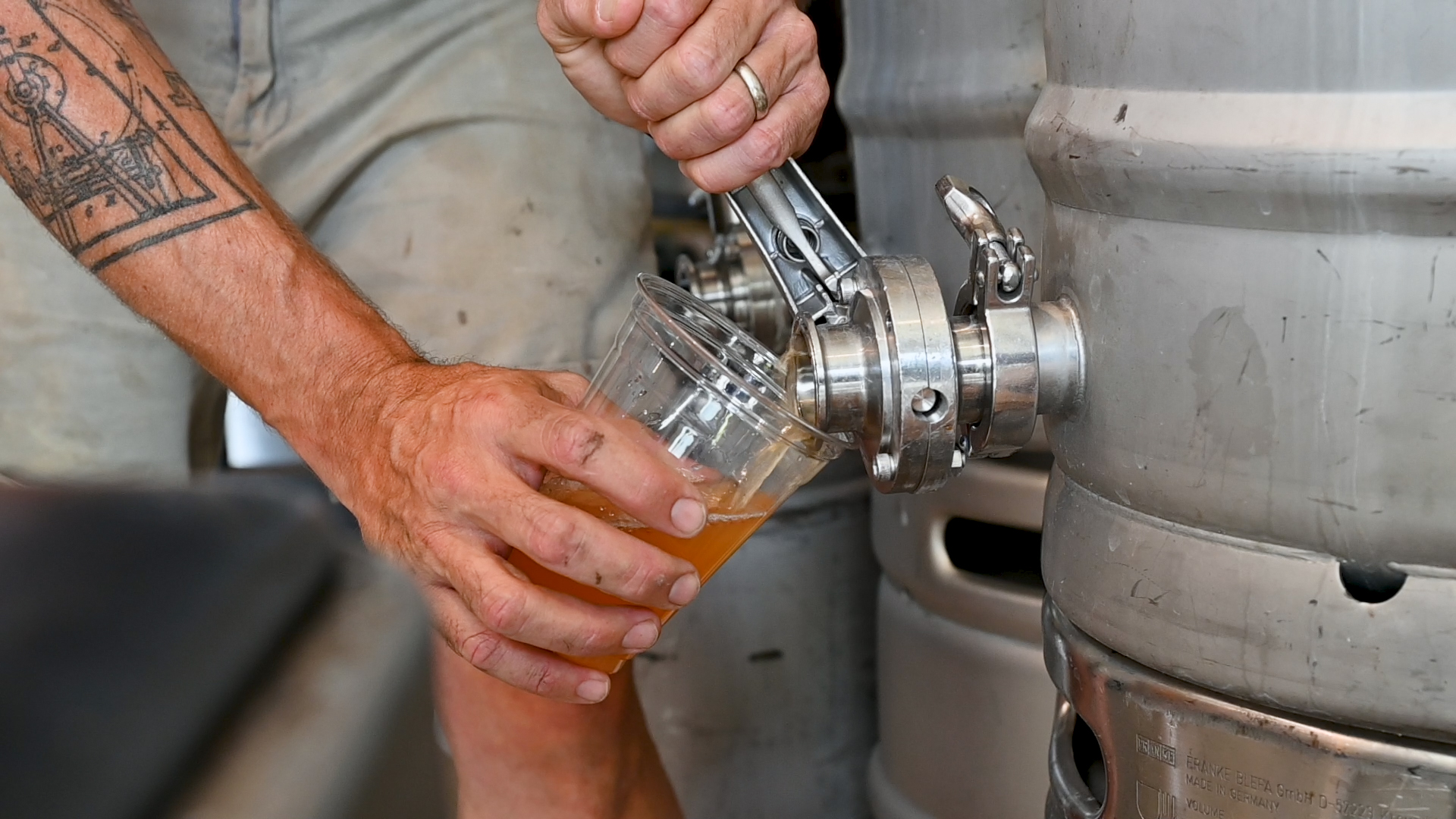
Drawing on ancient cuneiform tablets from the city of Girsu, the pair reconstructed two Mesopotamian beers: a golden beer brewed with emmer wheat and a darker, smokier beer made with roasted malt.
The tablets don’t technically contain recipes; they’re more like receipts, Paulette said.
“The first writing was essentially developed by the state to keep track of resources,” he said. “And so they were giving grain to a brewer, and then the brewer was making beer and keeping track of which ingredients they took in, how much beer they brewed, and how much beer they sent out.”
Paulette, an expert on ancient food systems, is particularly passionate about Sumerian beer culture, a topic he explores in his recent book, In the Land of Ninkasi: A History of Beer in Ancient Mesopotamia. He also incorporates the project into his courses at NC State, allowing students to see how experimental research can make the ancient world tangible today.
After Stewart read Paulette’s book, the two teamed up to recreate two beers that Paulette had cataloged: kaš sig (a golden beer) and kaš gi (a dark beer).


“From a brewing perspective, this is really exciting because from those cuneiform tablets, we have an idea of the ratio of different ingredients and how much liquid they procured from it,” Stewart said. “With that little bit of information, we can work backward to a recipe that we’re feeling pretty confident about.”
During their brew session at Trophy’s Maywood brewery in Raleigh, Stewart guided Paulette through the practical side of brewing while the two worked to stay true to the ingredients and methods that would have been used at the time. That included smoking malted barley over poplar wood, sweetening the darker beer with date syrup, and brewing the golden beer with emmer wheat, one of the world’s first domesticated crops.
Both beers used Paulette’s carefully prepared bappir, a mysterious Mesopotamian ingredient that scholars believe may have served as a fermentation starter. After borrowing sourdough starters from colleagues in a fermentation research group on campus, Paulette experimented with several methods: shaping barley-based doughs, then baking or dehydrating them into crumbly, bread-like cakes to preserve healthy yeast cultures.
“I felt like, wow — this could have been happening 4,500 years ago. You can imagine a building in the city of Girsu where someone was doing this, continually managing these actively growing sourdoughs.”
“It was really fun experimenting in my kitchen,” Paulette said. “I felt like, wow — this could have been happening 4,500 years ago. You can imagine a building in the city of Girsu where someone was doing this, continually managing these actively growing sourdoughs.”
Both beers debuted at the College of Humanities and Social Sciences’ Human Factor Speaker Series, where Paulette and Stewart served them to culinary icon Alton Brown and CHASS Dean Deanna Dannels.
After taking his first sip, Brown called them “utterly delicious,” comparing them to a dark malt Saison and a stout. “Oh hell yeah!” he exclaimed.
The project demonstrates how humanities research can come to life in unexpected ways — not just on the page, but in a glass. By pairing ancient texts with modern brewing science, Paulette and Stewart bridged millennia and gave today’s drinkers a literal taste of Sumerian culture.


For Paulette, the effort underscores the role of food and drink in connecting people across time — and has stirred new areas of inquiry.
“This kind of experimental work is really good at generating new questions,” he said. “If I’m sitting at my computer trying to understand how they brewed beer, that’s one thing. But actually brewing with professionals is totally different — and what you get, over and over again, are new questions. That, to me, is what’s valuable about a project like this.”
And the ideas are already bubbling. Paulette and Stewart are eyeing new research directions — and more experiments in ancient beer — as they continue raising fresh questions and new pours from the world’s oldest brewing traditions.
- Categories:


