NC State Web Platform Unlocks Arabic Family Histories

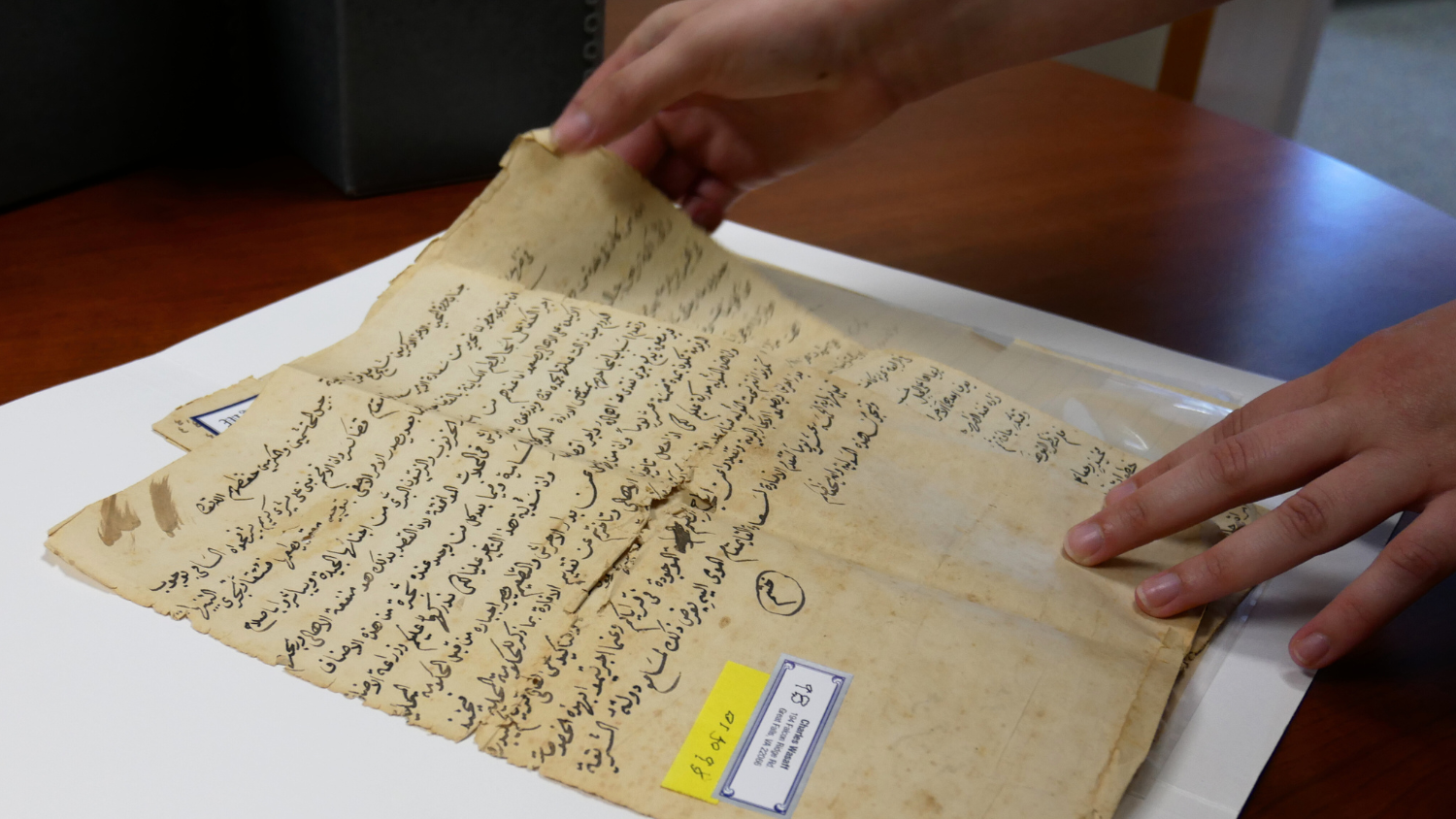
Eighty-four handwritten Arabic letters sat carefully preserved but unread for decades. Written by Charles Wassaf’s grandfather after emigrating from ‘Amchit, Lebanon, to Shreveport, Louisiana, in the late 1890s, they held generations of ancestral history locked inside a language no one in the family could read.
That changed when Wassaf turned for help to NC State’s Moise A. Khayrallah Center for Lebanese Diaspora Studies. Researchers there used Fihris.org, the center’s new Arabic archival AI-powered web platform, to translate his grandfather’s letters.
The center developed Fihris over the last two years to transcribe and translate handwritten Arabic documents from the 1860s to the 1960s. In less than 30 minutes, the platform processed Wassaf’s letters, a task that would have taken a translator several hours and at a great cost with inaccuracies.
“Two hours later, Charles called me with tears in his eyes and deep gratitude in his voice for allowing him for the first time, to ‘hear’ his grandfather’s voice, and no less to understand the story behind those letters,” said Akram Khater, the director of the Khayrallah Center and the Khayrallah Chair in Lebanese Diaspora Studies.
“Two hours later, Charles called me with tears in his eyes and deep gratitude in his voice for allowing him for the first time, to ‘hear’ his grandfather’s voice, and no less to understand the story behind those letters.”
Wassaf’s story is one shared by countless families whose handwritten Arabic letters hold pieces of their family history that have remained inaccessible for generations. By making those documents accessible, Fihris helps safeguard and share personal histories.
Preserving and sharing those stories is at the heart of the center’s mission. Through research, public scholarship and its archival collections – comprising more than 2,900 pages – the center works to preserve the history of the Arab diaspora while making it more accessible to scholars, students and families alike. Fihris, launched in February 2026, is one of the latest examples of the center’s work.
The platform uses the proprietary AI model the center developed to recognize handwritten Arabic script from the center’s archive, transcribe it into searchable text, and then translate it into English, French, Spanish, and Portuguese. The programming team is led by Mehreen Saeed, the center’s archival technologies specialist, and Chau-Wai Wong, an associate professor in the Department of Electrical and Computer Engineering. Its impact is already becoming clear.
Since its launch earlier this year, Khater said nearly 10,000 people have visited Fihris.org and interacted with the platform more than 60,000 times. The center also gathers feedback through webinars and focus groups, where participants consistently describe Fihris as a long-awaited, publicly available resource that helps families reconnect with their heritage.
“Arab Americans have been largely elided from institutional archives in the U.S. and elsewhere,” said Khater. “Thus, scholars and the general public have not been able to easily access individual, family and community stories. With Fihris, we can now make accessible those very histories.”
Though Fihris currently achieves approximately 85% accuracy, every transcription published through the platform is carefully reviewed by researchers. Those edits are used to improve the model, increasing its accuracy over time.
The team is also developing tools to better preserve the historical and cultural context behind each document. Researchers are creating a specialized lexicon of words and expressions commonly found in late 19th- and early 20th-century Arabic manuscripts so translations more accurately reflect the language, customs and experiences of the people who wrote them.
The platform’s multilingual design underscores the global reach of the Lebanese diaspora. Because some of the largest Lebanese diasporic communities settled in South America, providing Spanish and Portuguese translation capabilities allows the center to reconnect families and researchers across the Americas with their shared history.
Fihris is also changing what historians can learn from documents. As an example, Khater pointed to the diary of Hanna Gaith, who emigrated from present-day Syria in 1904, first to Brazil and later to Argentina. After his great-niece donated the handwritten diary to the Khayrallah Center in 2023, Fihris translated it into Spanish, revealing a rare first-hand account of the voyage of emigrants who left the Ottoman Empire for the Americas.
“Letters, diaries, account books and other Arabic handwritten documents that sat silent in a box or on a shelf can now tell us a great many new things about the intimate lives of Arab Americans, including their relationship with other communities, both in the U.S. and the rest of the Americas,” Khater added.
“Letters, diaries, account books and other Arabic handwritten documents that sat silent in a box or on a shelf can now tell us a great many new things about the intimate lives of Arab Americans.”
Looking ahead, the center plans to allow families to upload their own images of Arabic handwritten letters, diaries and manuscripts directly to Fihris. While that feature is still under development, the goal remains the same: to place tools for preserving history into the hands of the people whose stories have too often gone untold.
For Wassaf, the translations did more than unlock words on a page. They revealed that his grandfather, Shalhoub Yousef Rashed, mortgaged land in his hometown of ‘Amchit to finance his journey to Louisiana.
Rashed settled in Shreveport, where his cousin, pioneering Lebanese American author Afifa Karam, and a growing community of immigrants from their village had already established roots. There, he opened a store on Can Street, married and raised three daughters.
Those discoveries transformed a name on a family tree into someone Wassaf could finally know, a man whose sacrifices and determination shaped his family’s story.