
For most people, food is deeply personal. It connects us to specific moments in time — quiet mornings, joyful family gatherings, late-night study sessions — and to the people and places that shape who we are.
A single dish can trigger a childhood memory or the soothing presence of a loved one. Whether it’s a favorite comfort food or a recipe passed down through generations, these meals often carry stories as rich and complex as their flavors.
We spoke to five members of the College of Humanities and Social Sciences community, who shared a favorite recipe and its meaningful story. Each entry includes ingredients, directions and the personal connections that bring the recipe to life, offering a glimpse into the lives of those who make up our college.
From sweet to savory, each recipe demonstrates how food can preserve traditions, celebrate heritage, foster connection and nourish our bodies and spirits. Meet the people behind the recipes and relish their stories.


Deanna Dannels
Dean, College of Humanities and Social Sciences
Recipe: Pumpkin Bread
Every autumn growing up, the smell of pumpkin bread in the oven signaled the change of season to fall and the holidays. My brothers and I would help Mom bake over several weeks, and the loaves would disappear almost as fast as we made them. I lived on the bread in high school (every morning; breakfast of champions!).
In college, Mom sent me care packages filled with pumpkin bread – I was very popular in my dorm and apartment! I’ve continued baking pumpkin bread for my family as they’ve grown up, and though I know it by heart, I always pull out Mom’s handwritten recipe—a treasured item since she passed 17 years ago. And for the record, adding raisins or omitting chocolate chips is not acceptable!
Open to read recipe
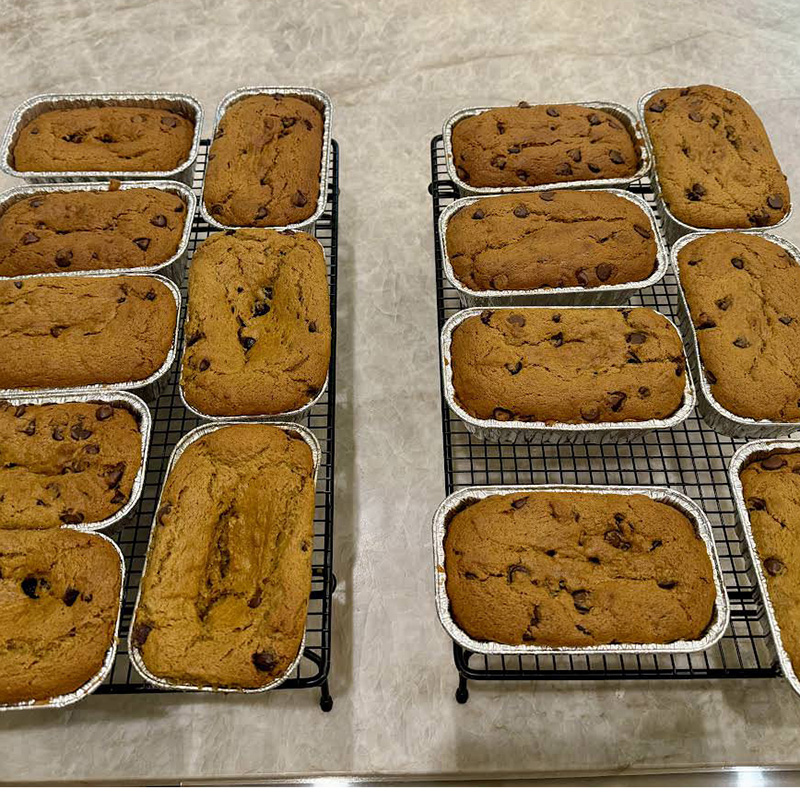
Each batch makes 3-4 small loaves or 1-2 large loaves.
I typically double or triple the recipe and make small loaves to share!
Preheat oven to 350°F
Ingredients:
- 1 ¾ cups flour
- 1 tsp baking soda
- 1 tsp cinnamon
- ½ tsp salt
- ½ tsp nutmeg
- ¼ tsp ground ginger
- ¼ tsp cloves
- ½ cup butter
- 1 cup sugar
- 2 eggs
- ¾ cup pumpkin (canned or fresh, roasted– if fresh, increase to 1 cup)
- 1 cup chocolate chips (or more or less, depending on preferences!)
Instructions:
- Mix spices with flour (soda, cinnamon, salt, nutmeg, ginger, cloves)
- Cream butter, add sugar, and cream well
- Blend in eggs and mix well
- At low speed, add dry ingredients ¼ cup at a time
- Alternate with adding pumpkin, a little at a time
- Begin and end with dry ingredients
- Add chocolate chips
- Spray and flour bread pans to avoid sticking
- Fill ¾ high with batter
- Bake 45-50 minutes for small loaves
- Bake 65-70 minutes for large loaves
- Bread is done when a toothpick comes out of the center of the bread pan clean

Nadia Minniti
Alumna, M.A. in Liberal Studies ’11
Owner, chef, pizzaiolo, Gusto Napoletano Italian Restaurant, Fayetteville
Recipe: Spaghetti All’Insalata
When my father died recently, I flew to Naples, Italy, to be with my mother, who asked me to cook the same meal for her every day. Her request was to prepare spaghetti all’insalata. Though all ‘insalata means in salad, it was what my father called a favorite cooked spaghetti and tomato dish.
My father was going blind and could barely cook because he was afraid of cutting himself. So, he cut everything big or not at all, tossed it in a pan, cooked it for 10 minutes, and then added spaghetti. I assume he named the dish “all’insalata” because the fresh sauce contains all the ingredients of a tomato salad. My mother wanted that dish because it was her way to feel close to him, or to pretend he was still there.
When I returned from Naples, I offered this dish in my restaurant as a special and in honor of my father.
Open to read recipe

Ingredients: 4 servings
- 12 oz. spaghetti cooked in salted water al dente
- 4 tablespoons of reserved pasta water
- 4 garlic cloves, peeled and smashed with the flat side of a chef’s knife
- 20 oz. of cherry tomatoes (not grape) or 3 heirloom German Johnson tomatoes
- 1 large bunch of fresh basil
- ¼ to 1/3 cup extra-virgin olive oil
- Salt and pepper to taste
Directions:
- While the water boils for the spaghetti, wash the tomatoes, and, if using cherry tomatoes, cut them in half, lengthwise.
- If you are using heirloom tomatoes, cut them into large dice. In a large skillet, pour the ¼ cup of oil and the garlic.
- Sauté on medium heat for 2 minutes, then add 1/3 of the basil (just the leaves) and stir.
- Cook for 2 minutes more.
- Add the cut tomatoes and lower the heat a bit under the skillet.
- Add 2 teaspoons of salt and a pinch of pepper, stir, and let cook for 5 to 7 minutes, stirring every once in a while.
- Check to see if spaghetti is done, as it only takes 5 to 6 minutes to be almost done.
- Add another third of the basil (just the leaves) to the skillet and stir, and then add 3 to 4 tablespoons of the pasta water to the skillet and stir.
- The starch from the pasta will create a better sauce.
- When spaghetti is al dente, remove it from the pasta water with tongs or by draining it in a colander and place it directly into the skillet.
- Toss with the tomatoes, cook for 2 minutes, stirring often, plate, garnish with the remaining basil leaves, and serve immediately.

Hans Peter Schmitz
Bob and Carol Mattocks Distinguished Professor
in Nonprofit Leadership
Recipe: Maultaschen, a regional dish from Southern Germany
My father was a professional cook who worked at a social service institution. My brother and I would always have lunch after school in the breakroom of his commercial kitchen.
We would hang out with the staff and always have the same (subsidized) meals, such as maultaschen (large, meat-filled dumplings made from pasta dough).
I don’t get to make maultaschen here in the U.S. However, I always order that dish or kaesespaetzle (the German version of macaroni and cheese) at a restaurant when I visit Germany.
Open to read recipe
- Dough Ingredients:
- 250g durum wheat flour
- 3 eggs
- 1 teaspoon extra virgin olive oil
- A pinch of salt
Making the dough:
- Place a heap of flour on a board and create a hole in the center.
- Add the eggs, the olive oil; knead everything into a smooth dough.
- It is best to use a little less flour first and knead the dough until it is soft, then add more flour until the desired consistency is reached.
- Roll out thinly.
Filling Ingredients:
- 200g leaf spinach
- 100g ground meat (or vegetarian alternative like fresh cheese)
- 1 bread roll, cut into very thin slices and soaked in a little warm milk
- 1 egg
- 3 tbsp marjoram
- 2 small onions, thinly sliced
- 3 bunches of parsley, finely chopped
- 1/2 leek
- Salt, pepper, nutmeg
Filling:
- Wash the spinach and wilt it in a pan with a little butter. Squeeze it well.
- Sauté the onions, parsley, and finely chopped leeks in butter until lightly browned.
- Place them on a board with the spinach and chop very finely.
- Let it cool and transfer everything to a bowl. Add the ground meat, the squeezed-out bread rolls, and the remaining ingredients.
- Knead for three minutes.
- Season with salt, pepper, marjoram, and nutmeg and keep kneading.
Directions:
- Spread the rolled-out pasta dough on a floured board and cut into 10-centimeter-long rectangles.
- Place an apricot-sized dumpling of filling in the center, brush the edges with a little egg (for adhesion), and place another piece of dough of the same size on top, pressing the edges firmly together.
- Now press the Maultasche flat with both hands to push out the trapped air and release it into the water.
- Let it simmer in lightly boiling salted water for about 10 minutes. Serve with brown butter, roasted onions in broth (as soup), or lightly sautéed with salad—anything goes.

Jen Willis
CHASS Advisory Board Chair
Alumna Master of Public Administration ’95
Recipe: Banana Pudding
This is a recipe that my great-grandmother Alice Faircloth cooked for family gatherings. “Granny” lived a good life for 91 years, dipping Tube Rose Snuff and enjoying a tumbler of burgundy every night before bed, “because it helped her sleep.”
She raised my mother and came to live with us when I was born, eventually becoming the official family cook.
Her pots of beans were never without fatback, and she might have weighed 90 pounds soaking wet. Each time Granny made this dessert, she’d taste it and declare, “I believe this is the best banana pudding I’ve ever made!” and it always was.
Open to read recipe
Ingredients: 6 servings
- 3/4 cup sugar, divided
- 1/3 cup all-purpose flour
- 1/4 teaspoon salt
- 2 cups scalded milk (I use whole milk)
- 2 eggs, separated
- 1 teaspoon vanilla extract
- 25 Nilla Wafers
- 4 bananas, sliced
Custard:
- Blend 1/2 cup sugar, flour, and salt in the top of the double boiler.
- Add milk and cook until thick, stirring constantly.
- Cover and cook for 15 minutes.
- Remove from heat.
- Beat egg yolks, combine with custard, and cook 2 minutes longer.
- Add vanilla
- Line a baking dish with Nilla wafers, add sliced bananas, and top with custard
- Repeat layers until ingredients run out
Merengue:
- Beat egg whites until stiff
- Add the remaining 1/4 cup of sugar and spread over the custard
- Bake at 350°F about 12-15 minutes
- If you don’t like merengue (I don’t), you can skip the final three steps. Mom usually tops the dish with crushed Nilla wafers. The pudding gets thicker as it cools.
Ashley Clemmer
Psychology major
Recipe: Butterscotch Pie
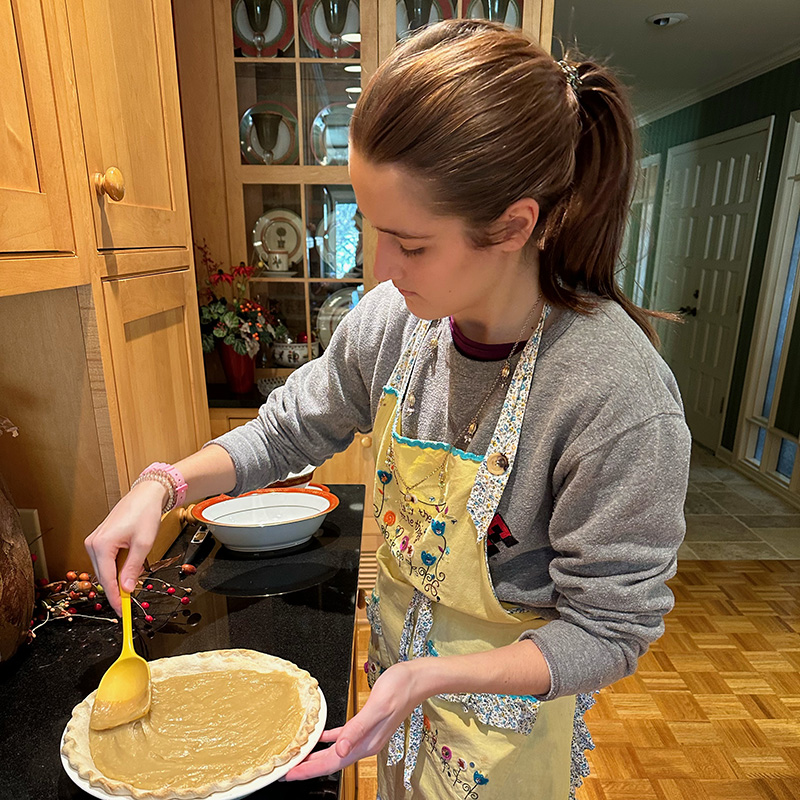
My great-grandma Katherine, who went by Kitty, created the butterscotch pie recipe. I didn’t get to see her very often, but I felt connected to her through this recipe, and I bake the pie every holiday season to bring my family together.
The relatives on my father’s side of the family tell me every year, “This tastes just like how Kitty made it.”
The recipe is five generations old and served in my grandmother’s pie dish, which is also five generations old. This butterscotch pie is more than a tasty dessert; it’s a way for my family and me to remember each other.
Open to read recipe

Crust:
- 1 ¼ cup all-purpose flour
- 1 tablespoon sugar
- ½ cup unsalted butter (fridge cold)
- ¼ cup ice eater
- 1 egg beaten
Directions:
- In a large mixing bowl, whisk together flour and sugar, and add a pinch of salt.
- Add the butter, and coat it in the flour.
- Crumble the butter till it’s in smaller chunks.
- Pour ice-cold water over the mixture and incorporate it, mixing minimally. The dough will hold together when smashed with your hands, but will still look dry and crumbly. Add more water if it’s too dry.
- Pat the dough into a circular disc, about the size of your palm. Wrap in plastic wrap and refrigerate for at least one hour before rolling.
- Preheat the oven to 375°F. Remove the dough from the refrigerator, lightly flour your surface, and roll to about 1/8 inch.
- Once the dough is about 9 inches wide and 1/8 th thick, lay the dough in your dish and trim/crimp the edges.
- Using a fork, poke holes in the bottom and sides of the crust. Freeze for 5-10 minutes.
- Once done freezing, fill the crust with weights of your choice, such as dried beans or rice.
- Cook for 15-20 minutes; the crust should be lightly golden brown and flaky.
- Remove from the oven, take out the weights, and brush the entire crust with the beaten egg mixture.
- Return to the oven and bake until a deeper golden brown; this will take another 15-20 minutes.
Filling:
- 6 tablespoons butter
- 6 tablespoons all-purpose flour
- 1 ½ cups packed brown sugar
- 2 cups whole milk
- 3 large egg yolks, room temp, beaten
- 1 teaspoon vanilla extract
Directions:
- In a saucepan, brown the butter. Once it turns a rich golden-brown color and smells slightly nutty, it is browned. Remove from heat, stir in flour until smooth. Stir in brown sugar.
- Return to heat and add milk. Cook over medium-high until thickened and bubbly. Reduce the heat, cook and stir for 2 more minutes.
- Remove from heat, stir one cup of hot filling into the egg yolks. This will temper the eggs to ensure they don’t scramble in the mixture.
- Once tempered, stir in the egg mixture and then bring the combined mixture to a gentle boil. Stir for two minutes.
- Remove from heat and stir in vanilla.
- Pour mixture into crust.
Meringue:
- 3 large egg whites, room temperature
- 1/4 th teaspoon cream or tartar
- ½ cup sugar
Directions:
- Using a mixer, beat the eggs whites and cream of tartar on medium speed until soft peaks. The peaks of the meringue should flop over.
- Add the sugar 1 tablespoon at a time on high speed until stiff glossy peaks form. They should stand up straight and not wiggle.
- Spread the meringue over the hot filling, carefully sealing the crust.
- Bake until the meringue is golden brown, 12-15 minutes.
- Cool for at least 1 hour and refrigerate for at least 3 hours before serving.
- Refrigerate any leftovers.
- Categories:


